
5.2 γ-γ 对称矩阵的整体减本底:Radware approach
本节讨论一种二维对称矩阵的整体减本底方法,它的基本思路是:
- 由二维 $\gamma-\gamma$ 矩阵得到 total projection;
- 将 total projection 近似分解为 peak component 和 background component;
- 根据这两个一维成分构造二维 background matrix;
- 从原始二维矩阵中扣除 background matrix;
- 在扣本底后的矩阵上进行开窗(gate),检查符合关系。
ROOT文件
本节继续使用 5.0 中得到的 addback 后数据文件:
eurica_addback.root
构建二维 $\gamma-\gamma$ 对称矩阵
二维 $\gamma-\gamma$ 矩阵的一个 bin $(E_i,E_j)$ 表示在同一个 prompt coincidence 中,两个 addback hit 的能量分别为 $E_i$ 和 $E_j$。
对于同一事件中的两个 addback hit,先计算时间差
$$ \Delta t = t_i - t_j. $$
若
$$ |\Delta t| < t_{\mathrm{prompt}}, $$
则认为这两个 hit 属于 prompt coincidence,并将其能量填入二维矩阵。
为了构造对称矩阵,每一个 $\gamma-\gamma$ pair 同时填入
$$ (E_i,E_j) $$
和
$$ (E_j,E_i). $$
这样得到的矩阵满足
$$ M_{ij}=M_{ji}. $$
下面的代码直接从 eurica_addback.root 构造二维对称矩阵。为了检查时间窗,同时保存一个对称填充的时间差谱 hdt_sym。这里 hdt_sym 只用于观察时间结构,不用于归一化。
本节与 5.1 使用相同的 30 keV 阈值、180 ns prompt 半宽和不同代表晶体条件。矩阵每轴 0–1500 keV、1 keV/bin;全矩阵填充数与普通 bin 内的计数分别输出,区间外事例留在 overflow,不纳入下面的投影及归一化。
运行环境:同目录的 JSROOT 输出兼容文件用于处理 ROOT 6.40 大矩阵的无损压缩;下面的初始化只影响 notebook 显示传输,不改变 bin、误差或分析结果。图仍由 %jsroot on 自然输出。
%python from jsroot_large_output import enable; enable()
%%cpp -d
#include <iostream>
#include <cmath>
#include <algorithm>
const int MAXHIT = 1024;
void make_symmetric_gg_matrix(const char *infile = "eurica_addback.root",
const char *outfile = "eurica_ggmatrix.root",
int nbins = 1500,
double emax = 1500.0,
double emin = 30.0,
double dtPrompt = 180.0)
{
TFile *fin = new TFile(infile);
if (!fin || fin->IsZombie()) {
std::cout << "cannot open " << infile << std::endl;
return;
}
TTree *tree = (TTree*)fin->Get("tree");
if (!tree) {
std::cout << "cannot find tree" << std::endl;
fin->Close();
return;
}
int ahit;
int aid[MAXHIT];
double ae[MAXHIT];
double at[MAXHIT];
if (tree->GetMaximum("ahit")>MAXHIT) throw std::runtime_error("Increase MAXHIT before reading");
tree->SetBranchAddress("ahit", &ahit);
tree->SetBranchAddress("aid", aid);
tree->SetBranchAddress("ae", ae);
tree->SetBranchAddress("at", at);
TH1::SetDefaultSumw2(kTRUE);
TH2D *hgg = new TH2D("hgg",
"#gamma-#gamma symmetric matrix;E_{x} (keV);E_{y} (keV)",
nbins, 0, emax,
nbins, 0, emax);
TH1D *hdt_sym = new TH1D("hdt_sym",
"symmetric time difference spectrum;#Deltat (ns);counts",
800, -4000, 4000);
Long64_t nentries = tree->GetEntries();
for (Long64_t ientry = 0; ientry < nentries; ientry++) {
tree->GetEntry(ientry);
int nhit = ahit; // 容量已在读取数组之前检查,不截断 hit
for (int i = 0; i < nhit; i++) {
if (ae[i] < emin) continue;
for (int j = i + 1; j < nhit; j++) {
if (ae[j] < emin) continue;
if (aid[i] == aid[j]) continue;
double dt = at[i] - at[j];
double adt = std::fabs(dt);
hdt_sym->Fill(dt);
hdt_sym->Fill(-dt);
if (adt < dtPrompt) {
hgg->Fill(ae[i], ae[j]);
hgg->Fill(ae[j], ae[i]);
}
}
}
if (ientry % 2000000 == 0) {
std::cout << "processing " << ientry << " / " << nentries << "\r";
std::cout.flush();
}
}
std::cout << std::endl;
std::cout << "Prompt matrix fills = " << hgg->GetEntries()
<< "; regular-bin sum = " << hgg->Integral() << std::endl;
TFile *fout = new TFile(outfile, "recreate");
hdt_sym->Write();
hgg->Write();
fout->Close();
fin->Close();
std::cout << "symmetric gamma-gamma matrix saved to "
<< outfile << std::endl;
}
make_symmetric_gg_matrix();
processing 0 / 10370481 processing 2000000 / 10370481 processing 4000000 / 10370481 processing 6000000 / 10370481 processing 8000000 / 10370481 processing 10000000 / 10370481 Prompt matrix fills = 5.22831e+06; regular-bin sum = 5.19455e+06 symmetric gamma-gamma matrix saved to eurica_ggmatrix.root
检查时间差分布和二维矩阵
TCanvas *c1 = new TCanvas("c1", "c1", 800, 700);
TFile *fg = new TFile("eurica_ggmatrix.root");
TH1D *hdt_sym = (TH1D*)fg->Get("hdt_sym");
TH2D *hgg = (TH2D*)fg->Get("hgg");
hdt_sym->Draw("hist");
c1->Draw();
二维 $\gamma-\gamma$ 对称矩阵
%jsroot on
hgg->Draw("colz");
gPad->SetLogz();
c1->Draw();
Total projection 与一维本底分解
设二维对称矩阵为 $M_{ij}$。沿一个方向投影得到 total projection:
$$ P_i=\sum_j M_{ij}. $$
其中 $P_i$ 表示二维矩阵中与第 $i$ 个能量 bin 相关的总符合计数。
.L peaks.C
TCanvas *c2 = new TCanvas("c2", "c2", 1000, 600);
TH1D *hproj = hgg->ProjectionX("hproj",1,hgg->GetNbinsY());
hproj->SetTitle("total projection spectrum;E_{#gamma} (keV);counts");
peaks("hproj");
gPad->SetLogy();
c2->Draw();
Total projection 中既包含 full-energy peaks,也包含 Compton continuum 和 quasi-continuum。Radware approach 首先将 total projection 近似分解为
$$ P_i=p_i+b_i. $$
其中:
- $p_i$ 是第 $i$ 个 bin 中的 peak component;
- $b_i$ 是第 $i$ 个 bin 中的 background component。
这里的 $p_i$ 和 $b_i$ 不是对每一个物理峰逐峰拟合得到的结果,而是从 total projection 中估计出的平均 peak / background 成分。
使用 TSpectrum::Background() 估计一维本底。
其中:
hproj对应 $P_i$;hbg1d对应 $b_i$;hpeak1d对应 $p_i$。
TSpectrum::Background() 的参数需要通过图形检查。若本底线明显穿过强峰,说明本底估计过高;若本底线明显低于连续平台,说明本底估计过低。Radware approach 的效果首先取决于这一维分解是否合理。
TSpectrum *sp = new TSpectrum(500);
TH1D *hbg1d = (TH1D*)sp->Background(hproj, 6, "nosmoothing");
hbg1d->SetName("hbg1d");
hbg1d->SetTitle("1D background from total projection");
TH1D *hpeak1d = (TH1D*)hproj->Clone("hpeak1d");
hpeak1d->SetTitle("peak component of total projection");
hpeak1d->Add(hbg1d, -1.0);
TCanvas *c3 = new TCanvas("c3", "c3", 1100, 400);
c3->Divide(2,1);
c3->cd(1);
hproj->Draw("hist");
hbg1d->SetLineColor(kRed);
hbg1d->Draw("hist same");
gPad->SetLogy();
c3->cd(2);
hpeak1d->SetLineColor(kBlack);
hpeak1d->Draw("hist");
gPad->SetLogy();
c3->Draw();
Background matrix
设真实 $\gamma$ 跃迁能量为 $E$,测量能量为 $e$。探测器响应函数记为
$$ R(e,E)=R_p(e,E)+R_b(e,E), $$
其中 $R_p$ 表示 full-energy peak response,$R_b$ 表示 background response。
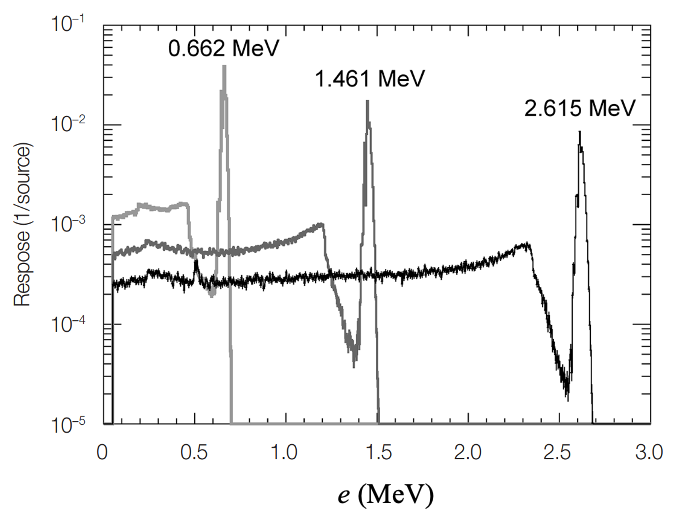
若真实符合 $\gamma$ 对 $(E_1,E_2)$ 在当前实验条件下进入二维矩阵的权重为 $W(E_1,E_2)$,则实验二维符合谱为
$$ M(e_x,e_y) = \int dE_1dE_2\, W(E_1,E_2) R(e_x,E_1) R(e_y,E_2). $$
代入 $R=R_p+R_b$,二维谱可以分成
$$ M=M_{pp}+M_{pb}+M_{bp}+M_{bb}. $$
其中 $M_{pp}$ 表示两个方向都来自 full-energy peak 的真实符合,应该保留;而
$$ B_{\mathrm{exact}} = M_{pb}+M_{bp}+M_{bb} $$
是严格意义下的二维本底,因为它们至少有一个方向来自 background response。
Radware 本底矩阵
- D. C. Radford, “Background subtraction from in-beam HPGe coincidence data sets,” Nuclear Instruments and Methods A 361 (1995) 306–316. DOI: 10.1016/0168-9002(95)00184-0.
严格本底的计算需要知道真实符合关系 $W(E_1,E_2)$ 以及每条 $\gamma$ 的响应函数 $R_p$ 和 $R_b$,实际分析中通常无法做到。Radware 方法因此采用一个全局平均近似。
首先定义 total projection:
$$ P(e)=\int M(e,e')\,de', $$
并将其分成 peak 和 background 两部分:
$$ P(e)=p(e)+b(e). $$
这里 $P(e)$ 不是普通 singles spectrum,而是二维 $\gamma-\gamma$ 谱的边缘分布;$p(e)$ 和 $b(e)$ 分别表示这个边缘分布中的 peak 成分和 background 成分。
Radware 方法用 $p(e)$ 和 $b(e)$ 的一维平均形状近似二维本底中的三类贡献:
$$ M_{pb}(e_x,e_y) \approx \frac{p(e_x)b(e_y)}{T}, $$
$$ M_{bp}(e_x,e_y) \approx \frac{b(e_x)p(e_y)}{T}, $$
$$ M_{bb}(e_x,e_y) \approx \frac{b(e_x)b(e_y)}{T}, $$
其中
$$ T=\int P(e)\,de. $$
因此 Radware 本底矩阵为
$$ B_{\mathrm{RW}}(e_x,e_y) = \frac{ p(e_x)b(e_y) + b(e_x)p(e_y) + b(e_x)b(e_y) }{T}. $$
利用 $P(e)=p(e)+b(e)$,也可以写成
$$ B_{\mathrm{RW}}(e_x,e_y) = \frac{ P(e_x)P(e_y)-p(e_x)p(e_y) }{T}, $$
这个近似的物理含义是:Radware 方法不再逐条计算真实 $\gamma$ 的 Compton continuum 和 partner 关系,而是用 total projection 中的平均 peak/background 分布构造二维本底。因此,它是一种全局平均本底估计,而不是严格的二维响应函数计算。
- 上述方法可以推广到 3-fold,4-fold的矩阵
其他方法:
- G. Palameta and J.C. Waddington, Nucl. Instr. Meth. A234(1985)476
- TSpectrum2的Background()方法
原论文给出了这个近似的推导及适用条件。上面的响应分解先讨论真符合;若输入 prompt 矩阵仍含随机的 peak–peak 组合,它们也会进入 peak–peak 成分,不能靠这一个公式自动识别。
Radware 方法的 ROOT 实现
下面根据
$$ B_{ij} = \frac{P_iP_j-p_ip_j}{T} $$
构造 background matrix,并从原始矩阵中扣除。
%%cpp -d
#include <iostream>
#include <cmath>
#include <algorithm>
void make_radware_matrix(const char *infile = "eurica_ggmatrix.root",
const char *matrixName = "hgg",
const char *outfile = "eurica_gg_radware.root",
int bgIter = 6)
{
TFile *fin = new TFile(infile);
if (!fin || fin->IsZombie()) {
std::cout << "cannot open " << infile << std::endl;
return;
}
TH2D *hgg = (TH2D*)fin->Get(matrixName);
if (!hgg) {
std::cout << "cannot find matrix " << matrixName << std::endl;
fin->Close();
return;
}
TH1::SetDefaultSumw2(kTRUE);
TH1D *hproj = hgg->ProjectionX("hproj",1,hgg->GetNbinsY());
hproj->SetTitle("total projection spectrum;E_{#gamma} (keV);counts");
TSpectrum *sp = new TSpectrum(500);
TH1D *hbg1d = (TH1D*)sp->Background(hproj, bgIter, "nosmoothing");
hbg1d->SetName("hbg1d");
hbg1d->SetTitle("1D background from total projection");
TH1D *hpeak1d = (TH1D*)hproj->Clone("hpeak1d");
hpeak1d->SetTitle("1D peak component from total projection");
hpeak1d->Add(hbg1d, -1.0);
int nx = hgg->GetNbinsX();
int ny = hgg->GetNbinsY();
TH2D *hggb = (TH2D*)hgg->Clone("hggb_radware");
hggb->Reset();
hggb->SetTitle("Radware background matrix;E_{x} (keV);E_{y} (keV)");
TH2D *hggmat = (TH2D*)hgg->Clone("hgg_radware");
hggmat->SetTitle("background-subtracted #gamma-#gamma matrix;E_{x} (keV);E_{y} (keV)");
double T = hproj->Integral();
if (T<=0) throw std::runtime_error("Empty projection");
for (int ix = 1; ix <= nx; ix++) {
double Pi = hproj->GetBinContent(ix);
double pi = hpeak1d->GetBinContent(ix);
for (int iy = 1; iy <= ny; iy++) {
double Pj = hproj->GetBinContent(iy);
double pj = hpeak1d->GetBinContent(iy);
// T 已在循环前检查;此处直接对应上面的本底公式。
double Bij = (Pi * Pj - pi * pj) / T;
// 保留模型计算结果,不把扣除后的负波动截为零。
hggb->SetBinContent(ix, iy, Bij);
hggb->SetBinError(ix, iy, 0.0); // 条件误差:未包含从本矩阵估计 B 的不确定度
}
}
hggmat->Add(hggb, -1.0);
TFile *fout = new TFile(outfile, "recreate");
hgg->Write("hgg_input");
hproj->Write();
hbg1d->Write();
hpeak1d->Write();
hggb->Write();
hggmat->Write();
fout->Close();
fin->Close();
std::cout << "Radware background-subtracted matrix saved to "
<< outfile << std::endl;
}
make_radware_matrix();
Radware background-subtracted matrix saved to eurica_gg_radware.root
检查 background matrix 和扣本底矩阵
TFile *fr = new TFile("eurica_gg_radware.root");
TH2D *hgg_input = (TH2D*)fr->Get("hgg_input");
TH2D *hggb_radware = (TH2D*)fr->Get("hggb_radware");
TH2D *hgg_radware = (TH2D*)fr->Get("hgg_radware");
c1->Clear();
hggb_radware->Draw("colz");
gPad->SetLogy(0);
gPad->SetLogz();
c1->Draw();